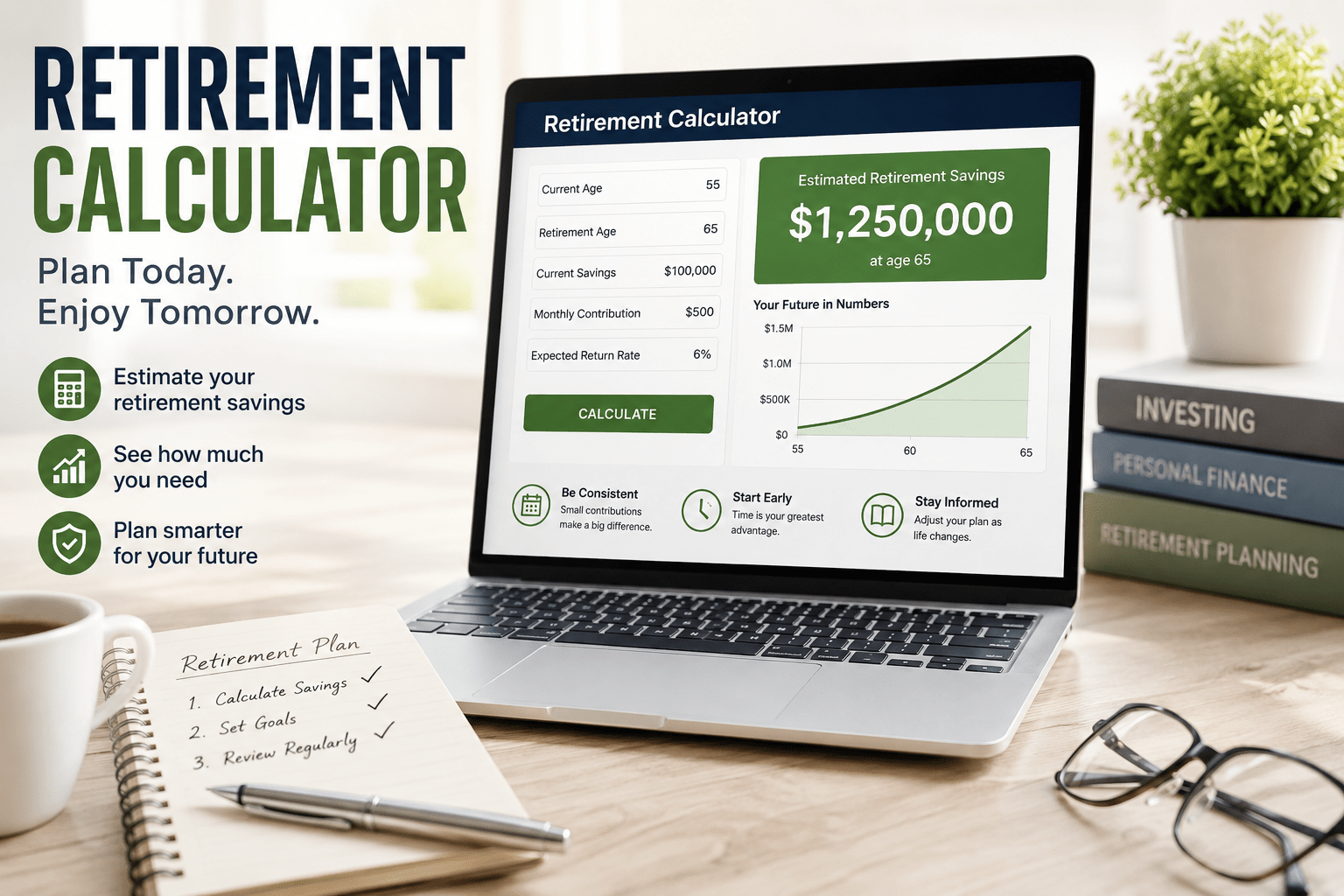
Retirement Calculator
Fill in your numbers to see where you stand.
Retirement Readiness Score
—
Fill in the form and calculate to see your score.
Estimated Retirement Savings
$0
at retirement age
Monthly Retirement Income
$0
from savings, 4% rule
Years Until Retirement
0
years of growth ahead
Retirement Savings Gap
$0
vsyour goal
Safe Withdrawal Amount
$0
4% rule, per month
Inflation-Adjusted Value
$0
in today’s dollars
Contribution Impact
$0
growth from your contributions
Retirement Feasibility
—
based on your inputs
What-If Scenarios
See how small changes move your outcomeUpdates automatically — nothing to click.
Savings Growth Over Time
Income vsExpenses Projection
Retirement Goal Gap
Inflation Impact on Purchasing Power
Insights for Your Plan
Retirement Calculator: How Much Money Do You Really Need to Retire?
Planning for retirement starts with one question that's harder to answer than it sounds: how much do I need to retire? A retirement calculator turns that vague worry into a concrete number — one based on your age, savings, investment returns, and the lifestyle you actually want.
What is a retirement calculator?
A retirement calculator is a free tool that projects your future savings and tells you whether you're on trackInstead of guessing, you enter a handful of numbers — your current age, how much you've already saved, what you contribute each month, and your expected investment return — and the calculator does the math for you.
A good retirement savings calculator goes beyond a single numberIt should also show you:
- Years until retirement — how much time your money has left to grow
- Inflation-adjusted value — what your nest egg is actually worth in today's purchasing power
- Safe withdrawal amount — based on the well-known 4% rule
- A readiness score — a simple 0–100 score showing how close you are to your goal
Why "today's dollars" matters
One of the most overlooked parts of retirement planning is inflationA million dollars sounds like a lot — but 30 years from now, after inflation quietly erodes its purchasing power, it may only buy what $400,000–$500,000 buys todayThat's why a reliable retirement calculator with inflation built in gives you a far more honest picture than a simple compound-interest projection.
The 4% rule, explained simply
Most retirement calculators lean on a classic guideline: the 4% ruleIt says you can withdraw 4% of your retirement savings in your first year of retirement, then adjust that amount for inflation every year after, with a strong chance your money lasts 30 years.
In practice, this means:
Required nest egg ≈ Desired annual income × 25
If you want $60,000 a year in retirement income, the 4% rule suggests you'd want roughly $1.5 million saved by the time you retire — before accounting for Social Security, pensions, or other income.
Who should use a retirement calculator?
- People in their 20s and 30s who want to know if their current savings rate is enough, or whether they should increase it now while compounding still has decades to work
- People in their 40s and 50s doing a mid-career check-in to see if they're behind, on track, or ahead
- Anyone considering early retirement (FIRE) who wants to test different retirement ages and see how each one changes their readiness score
- Couples planning together who want a shared, judgment-free number to plan around
What-if scenarios: the real value of a good calculator
A static answer ("you'll have $850,000") isn't very useful on its ownThe real value comes from asking what if:
- What if I save $200 more per month?
- What if I retire at 62 instead of 67?
- What if my investments return 1% more per year?
- What if I cut my expenses by 10%?
A good retirement calculator lets you drag a slider and watch your projected savings and readiness score update instantly — turning an abstract financial plan into something you can actually feel and adjust.
A simple way to start
You don't need a financial advisor, a spreadsheet, or a login to get a useful first estimatePlug in eight basic numbers — current age, retirement age, current savings, monthly contribution, expected return, inflation rate, desired income, and life expectancy — and you'll get an instant, visual breakdown of where you stand.
It won't replace personalized financial advice, but it will replace the guessing.
You might like :


